Categories
Reviews

Refresh Magazine – “Nature After Nature”


Old Master in the algocene

Rectangle presents “Old Master” at Wouters Gallery in Brussels, bringing together six artists — Alexandra Crouwers, Auriea Harvey, Joan Heemskerk, Jan Robert Leegte, Lorna Mills, and Clement Valla — whose practices map the entanglement of ecology and digital infrastructure. Working across photogrammetry, net art, GIF animation, generative software, and 3D scanning, their work converges on a condition rather than a thesis: the digital does represent nature. It has become part of its fabric.

Nature is not a backdrop to human civilisation. It is not something external that we act upon from a position of sovereign distance. We are inside it, and what we are unravelling is not nature in the abstract but the precise conditions that sustain us, and countless other forms of life, in their specificity. The ecological crisis is not a crisis of nature. It is a crisis of cohabitation, and it demands a post-anthropocentric rethinking of what constitutes an entity, what constitutes agency, and what constitutes our habitat.

That rethinking has entered a second phase. The Algocene names the moment at which algorithmic systems superimpose a pervasive digital infrastructure upon the physical transformations already in progress. A new nature has been taking shape, post-natural, hybrid, neither fully organic nor fully synthetic. The digital is not a representation of this emergent nature. It is embedded within it, an invisible yet decisive stratum that conditions every relation between organisms and their environments. The boundaries between human, machine, and the living world have been superseded.

“Old Master”, presented by rectangle at Wouters Gallery, is about the representation of nature in the digital era. It is not a digital art exhibition. Digital art asks what the computer can do; art in the digital age asks what the world has become now that the computer is inside it. The distinction is ontological, and “Old Master” belongs entirely to the second category: the digital here is not the medium or the subject but the condition, a restructuring of reality so complete that no practice can stand outside it. The canonical old masters painted nature from a position of exteriority: the surveyed estate, the storm endured, the garden subdued. Their images were acts of possession. In the Algocene, that exteriority has been foreclosed. The image is immanent to the system it renders. The scan is embedded in the landscape it reconstructs. The algorithm is a participant in the ecology it models.

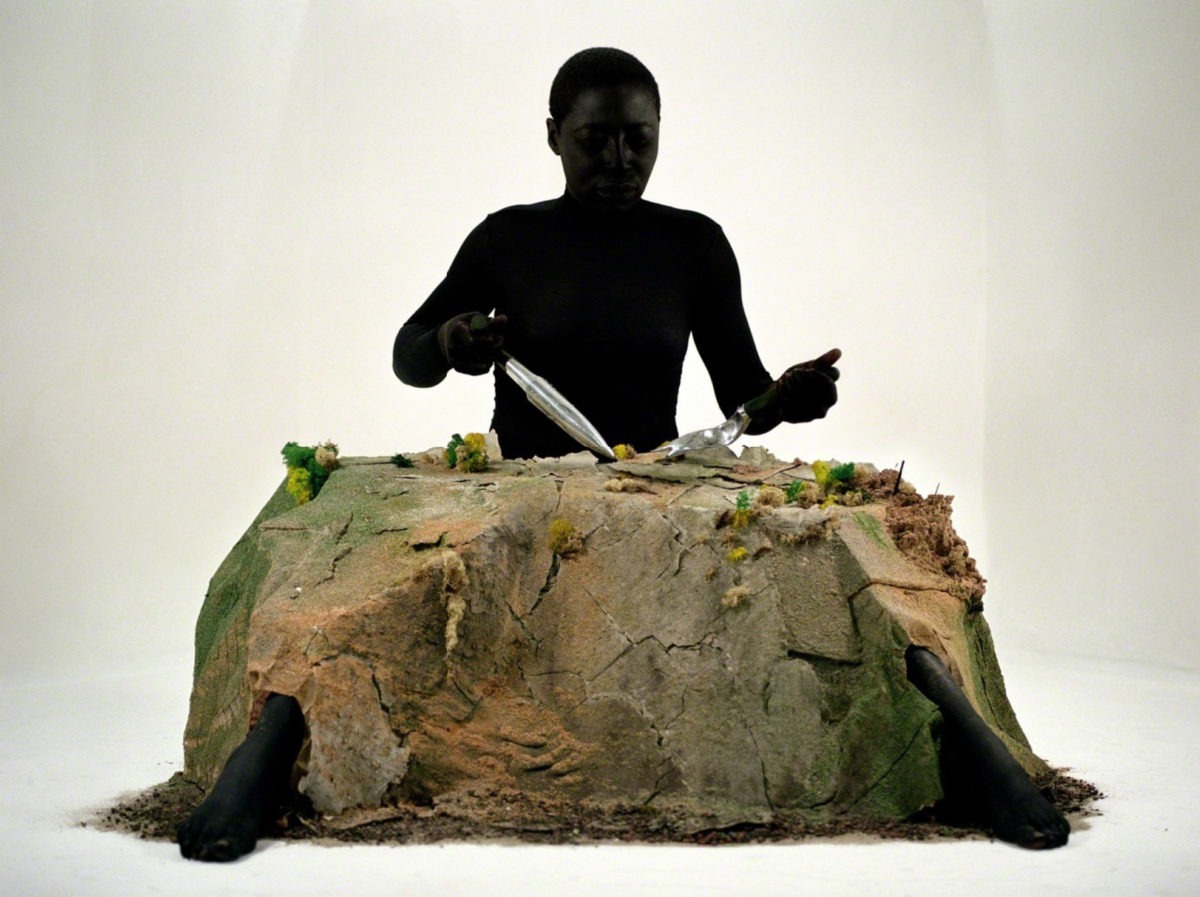
Alexandra Crouwers’s “Summoning a Forest” (2026) is a photogrammetric reconstruction of a clear-cut woodland annihilated by Ips typographus, the bark beetle whose proliferation was accelerated by successive droughts and the collapse of frost cycles. Crouwers presents not the resolved model but the process: raw point cloud, untextured mesh, ghostly blue tracking markers registering her own movements through the site. She appears in the reconstruction as a lacuna. The forest has ceased to exist. Its data persists in a condition that is neither archive nor monument, a geometric ghost occupying coordinates that have no season and no entropy. The accompanying audio piece The Compositor / Composing closes the circuit: the beetle’s tunnel system, traced to paper and run through image sonification software, produces a sound that was never intended as music and is all the more devastating for it. Ips typographus means compositor, the one who sets type. The insect inscribes; the software deciphers; the forest is transposed into code it never elected. The biological and the computational are not analogous here. They are continuous.

Jan Robert Leegte’s “Waves” (2026) extends that continuity into the digital’s own stratigraphic logic. Bleached interface fragments, the residue of web 2.0 platforms, text worn past legibility, are suspended in an oceanic simulation at the precise moment they are being replaced by AI systems that generate content on demand and leave nothing behind that can be located, stored, or cited. The digital is subject to erosion, sedimentation, and irreversible loss of form. The Algocene metabolises its own prior iterations. “Shadow” (2025) works through the inverse register: an unattributable square of darkness traverses a wind-tormented Unity landscape with the pace of a geological event, admitting no explanation and permitting no removal. The computational intrusion has been so thoroughly absorbed into the sensory world as to have become indistinguishable from it.

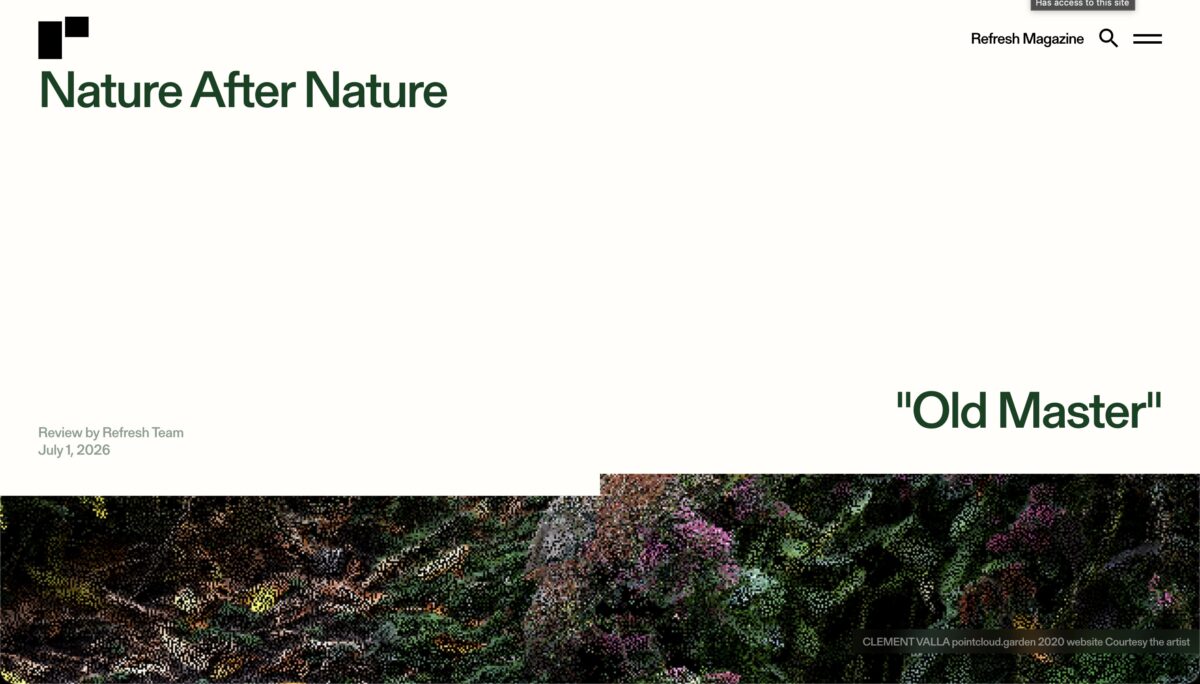
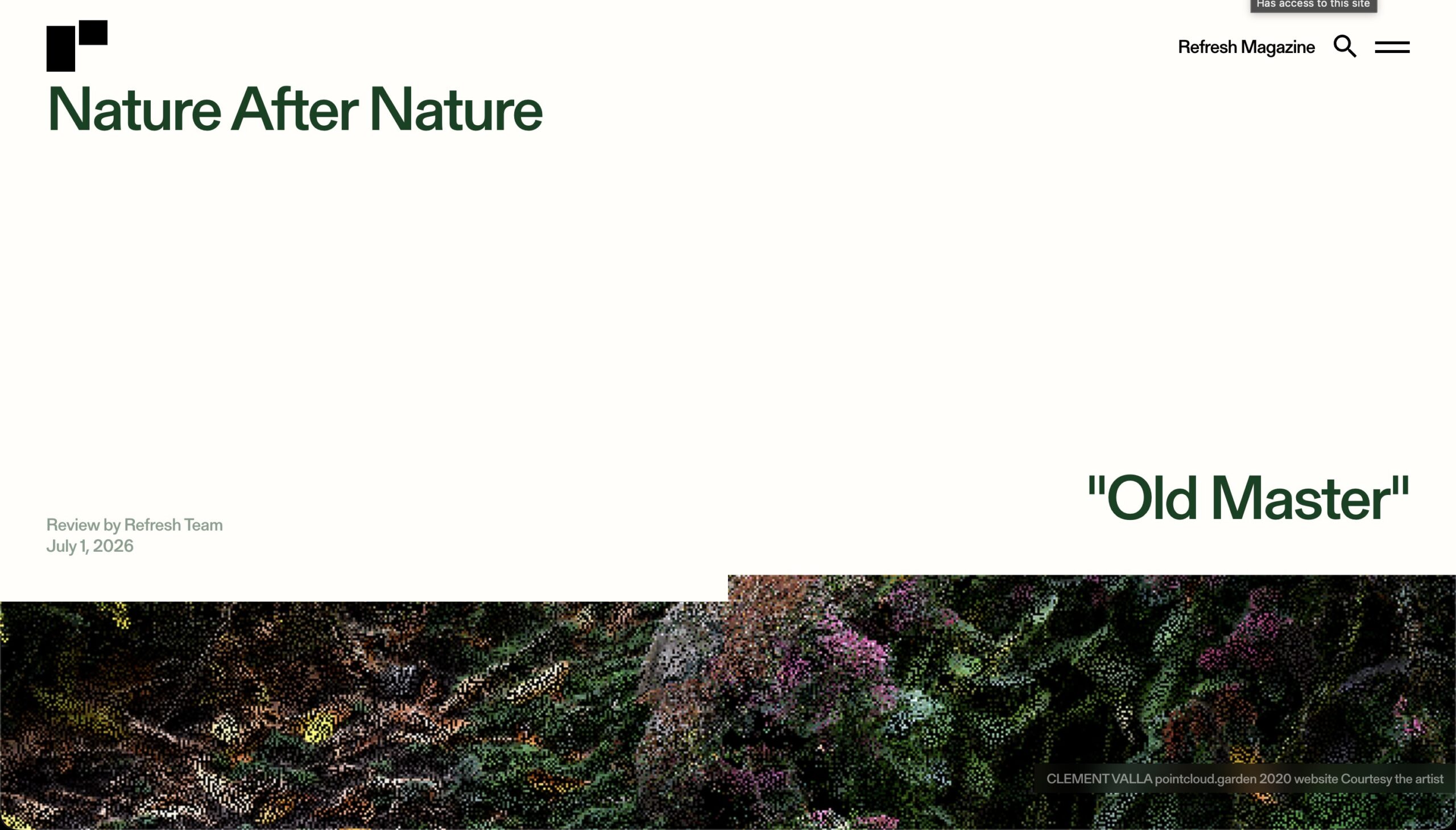
Clement Valla was a pioneer in understanding that the digitisation of the world is not a neutral act of recording but a system of choices, compressions, and distortions that produce their own version of reality. His earlier work exposed the structural failures of platforms like Google Maps, where the algorithm’s attempt to flatten a three-dimensional world onto a two-dimensional surface generates impossible geometries: bridges that fold into rivers, roads that dissolve into sky. The world, when processed, does not simply become data. It becomes a particular kind of data, shaped by the assumptions and limitations of the systems doing the processing. Pointcloud.garden (2020) and Overgrowth (2021) carry that inquiry into ecological territory. Gardens and yards released to rewilding are presented as raw 3D scan data, unprocessed, unresolved, held open at the threshold between image and object. The living world is now subject to the same biases, the same reductive translations, the same productive distortions that Valla identified in the digitisation of geography. The point cloud is not a representation of the garden. It is the garden in another state, shaped by the logic of the scanner as much as by the logic of growth. To relinquish a space to nature is also, now, to relinquish it to data. What appears to be a return is simultaneously a capture.

Joan Heemskerk’s Auquay (2019–ongoing) delineates the world’s coastlines exclusively from AIS shipping coordinates. The boundary between land and water is an artefact of signal infrastructure. The coast is where the data is.

Auriea Harvey’s Me and My Ghost (2001/2024) is a webcam capture reworked two decades after its making to exploit glitches that had not yet materialised when it was first produced. The digital has its own material temporality, its own modes of ageing and unforeseen mutation, its own capacity to become something other than what it was. Lorna Mills’s GIF animations, assembled from the most corrosive strata of the dark net, insist that the internet has an underside as decomposed and as generatively fecund as any ecosystem’s anoxic layer. Both works register the digital not as a clean infrastructure but as a living, degrading, self-transforming system, one that has acquired the opacity and the unruliness we once reserved for nature alone.

The title is precise. The old masters were not simply skilled painters. They were the authorised image-makers of a world in which nature was a resource, a spectacle, a possession. Old Master takes that authority and relocates it: to a moment in which the image-maker is inside the system being imaged, in which the forest and its scan, the coast and its signal, the garden and its data are not two things but one thing in two states. The Algocene has its own masters. They are working now.


Old Master — Wouters Gallery / rectangle, Brussels ( European Union) until 25 July 2026.

July 1, 2026, Refresh Team

more about Refresh Magazine
Categories
Reviews

BOOOOOOOM – “Revenants” Featuring Artists Kelly Richardson, Nicolas Sassoon & Rick Silva

Kelly Richardson, Nicolas Sassoon & Rick SIlva

BOOOOOOOM

at Rectangle, Brussels

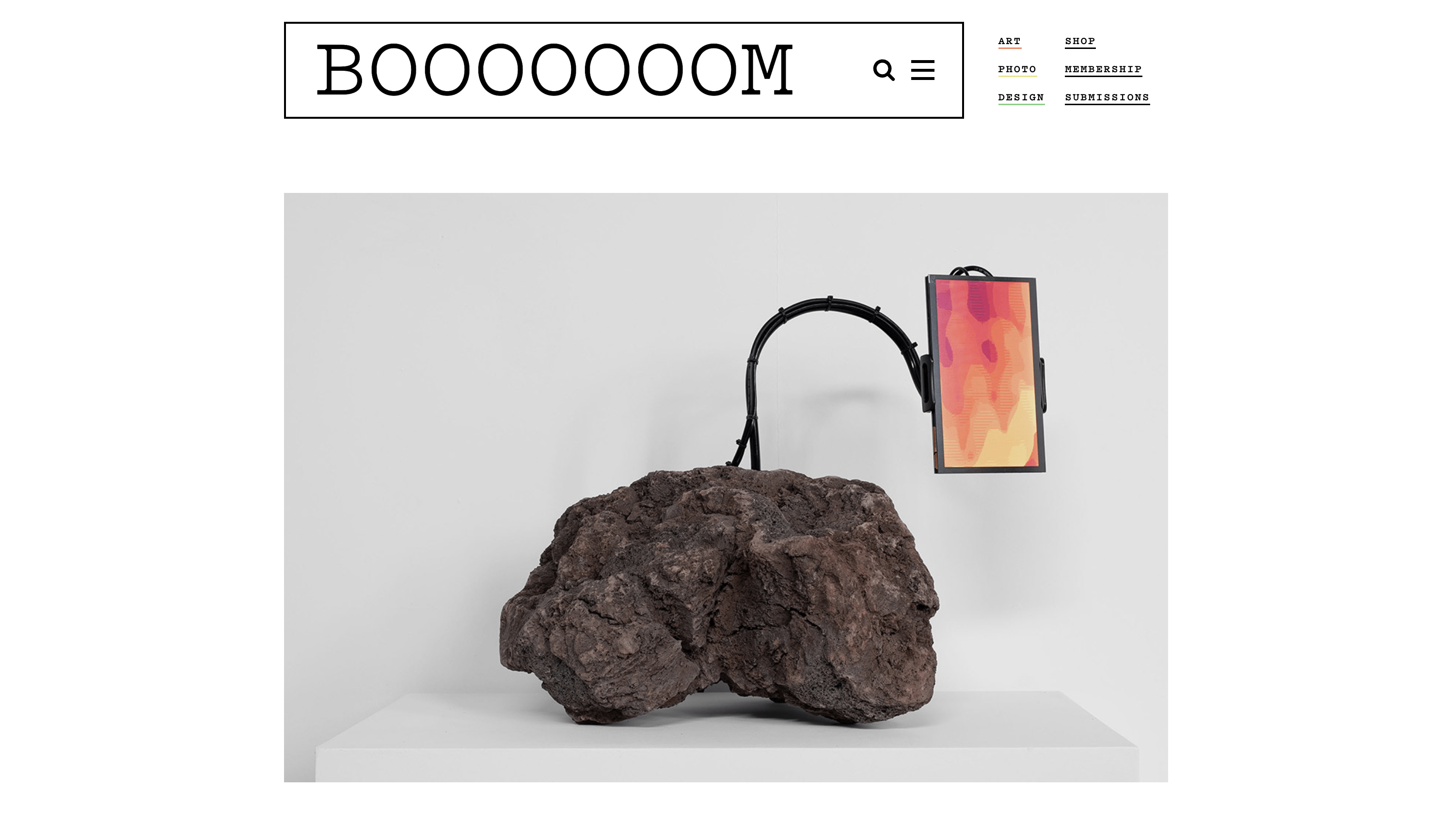
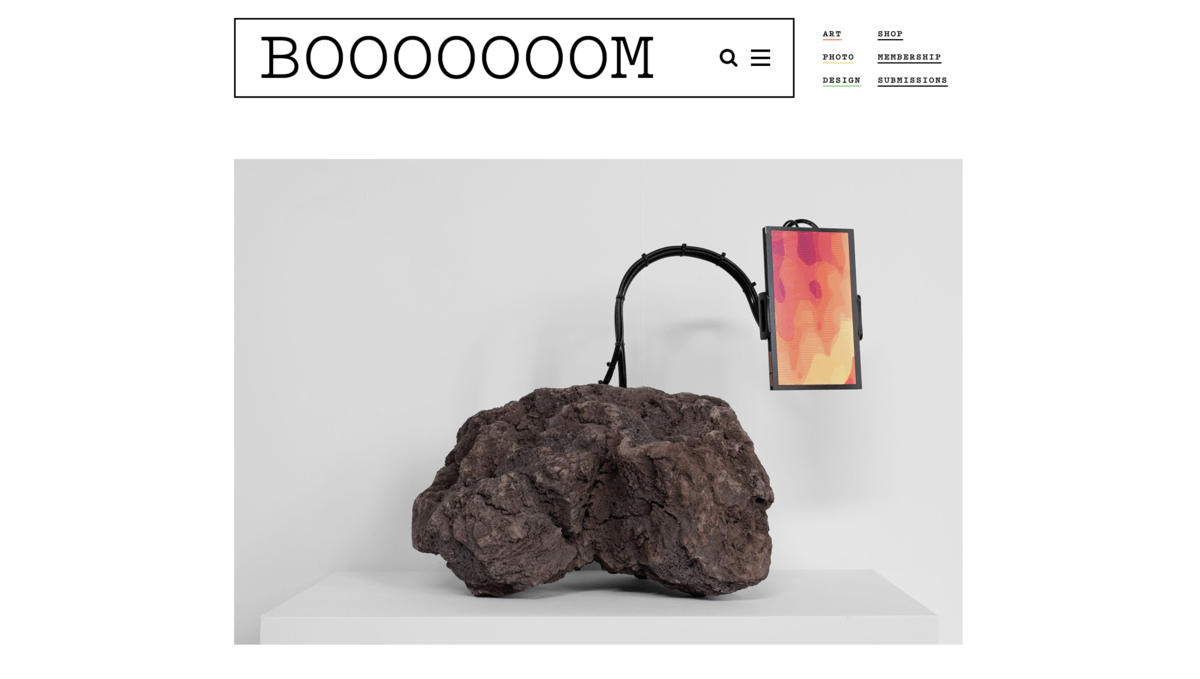
A new exhibition featuring Canadian artist Kelly Richardson, Franco-Canadian artist Nicolas Sassoon and Brazilian-American artist Rick Silva. Curated by Brussels-based art space Rectangle, “Revenants” plays with ideas of scale and time as it relates to human perception and our place on this planet. Sassoon’s ongoing sculpture series, “Prophets,” combines volcanic rock with LCD panels featuring pixelated animations reminiscent of flowing lava. Recalling traditional viewing stones, from which electronic hardware and screens emerge to form heads and figures, the sculptures recount a partial history of our relationship with matter and reminds us, not just of how the very ground beneath our feet was formed, but where the same minerals that enable our digital lives originate. Sassoon and Silva’s collaborative project similarly speaks to the connections between organic and inorganic materials as they share a common interest in depictions of wilderness and natural forms through computer imaging. “CORES” is made up of high-resolution 3D renderings of geological specimens altered by unnatural substances and enigmatic structures.

On the other end of the planetary spectrum, Richardson takes us into the asteroid belt of our solar system. Continuing ideas explored in “Pillars of Dawn” where extinct species in a seemingly post-human world have taken the form of crystals, “Origin Stories” reveals the majesty and infinite wealth of our home within the context of the universe. However intensely inward (historical / geological) or outward (celestial / futuristic) these artists may be looking, all the pieces in “Revenants” seem to come back to the same thing — what role or responsibility we still have yet to play. As Alexandra Crouwers states in her essay on the show:

“When we return to the human power of one, we’re left with the realisation that while our species’ behaviour is responsible for the current global extinction event, it’s equally capable of producing uniquely imaginative visions. Art alone can’t save the world but the creation of art may very well be considered as the yin to our destructive yang.”

Check out more images from “Revenants” below or on display at Rectangle in Brussels until February 20th.


“Revenants” Featuring Artists Kelly Richardson, Nicolas Sassoon & Rick Silva

Categories
Reviews

Hearts and Minds – Catalog Launch

Catalog Launch

Hearts and Minds

30 July 2021
at Rectangle, Brussels

Chantal Akerman
Harold Ancart
Jef Geys
Dan Graham
Bodys Isek Kingelez
Robert Lebeck
An-My Lê
Otobong Nkanga
Marina Pinsky
Claudia Peña Salinas
Adam Simon
Momoyo Torimitsu
Hil Ye

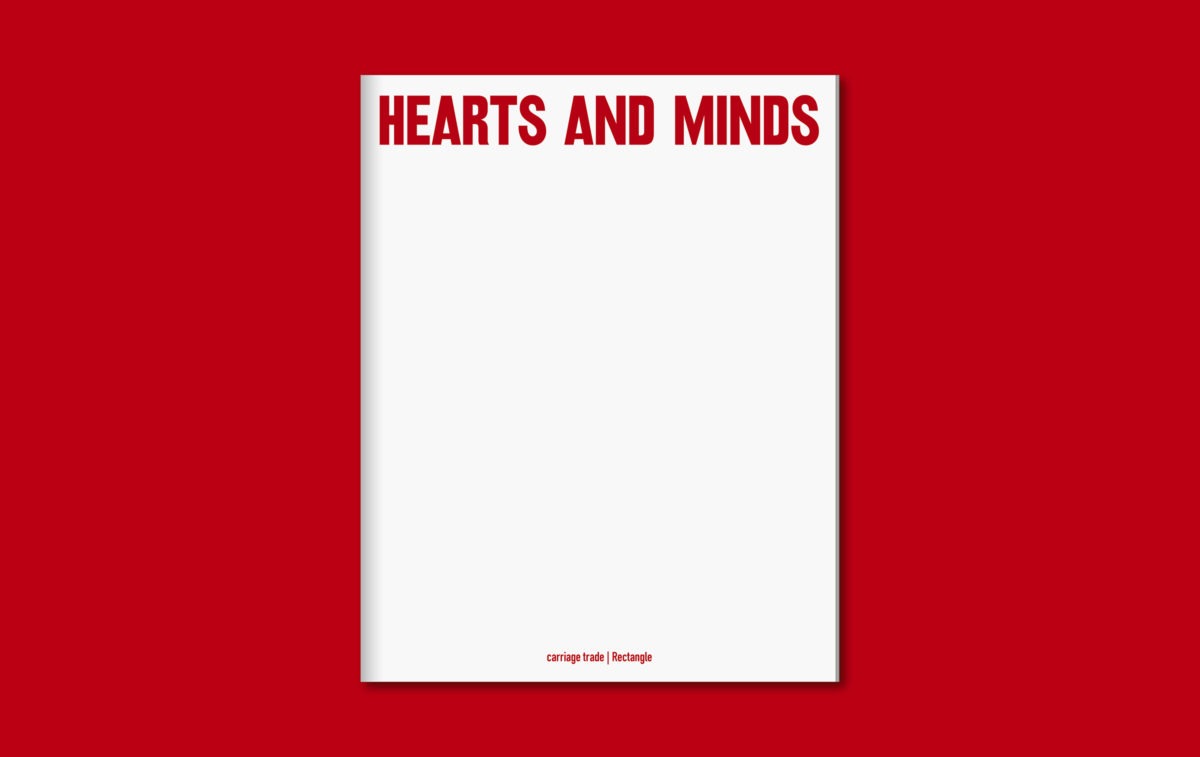
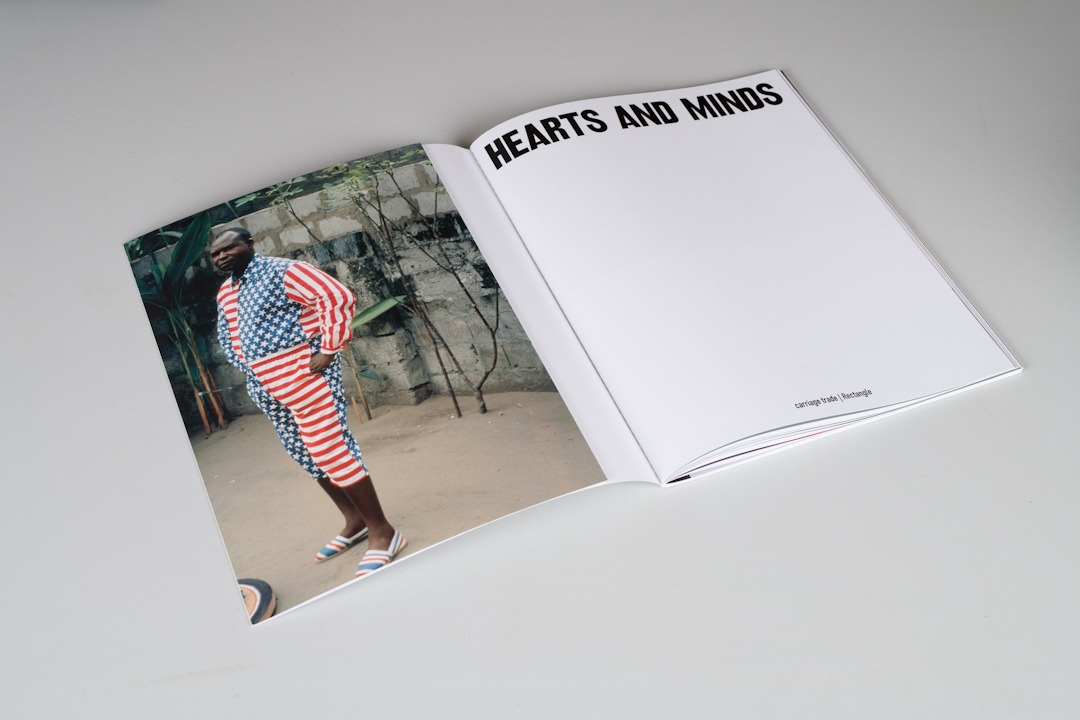
Rectangle is thrilled to invite you to the catalog launch of the group show
 Hearts and Minds,
a joint project of carriage trade / Rectangle

We’d like to thank all the artists and the following lenders for their loans of artwork for the exhibition:

Icarus Films (Chantal Akerman), Clearing Gallery, Brooklyn (Harold Ancart), Essex Street/Maxwell Graham (Jef Geys), Greene Naftali Gallery (Dan Graham), Ronald Guttman / Christine Martin, Frédéric de Goldschmidt / André Magnin (Bodys Isek Kingelez), Janice Guy (An-My Lê), Cordula Lebeck, Archiv Robert Lebeck (Robert Lebeck), Lumen Travo Gallery, Amsterdam (Otobong Nkanga), C L E A R I N G, Brussels (Marina Pinsky), and AfricaMuseum (Royal Museum for Central Africa).

A special thanks to Lawrence B. Benenson, LMCC, New York State Council on the Arts (NYSCA), Mr. Jacques Louise Vidal, WBI (Wallonie-Bruxelles International) and FWB (Fédération Wallonie-Bruxelles) for their generous support. Thanks also to gallery assistants Jervey Inglesby, Laura Li, Molly Miller, Hannah Park, Kristal Uribe, as well as Daylon Orr, for all their efforts on the exhibition.

With the gracious support of

Categories
Reviews

Revealing the Prickly Side of Imperial “Soft Power” – Hyperallergic

Revealing the Prickly Side of Imperial “Soft Power”
by Billy Anania
Hyperallergic

Otobong Nkanga, "Alterscape Playground (E)" (2005-2015), C-print on aluminium, 19 7/10 × 26 2/5 inches (courtesy the artist and Lumen Travo Gallery, Amsterdam)

A collaboration between Carriage Trade and Rectangle, Hearts and Minds analyzes the deceptive repackaging of Western imperialism.

At its core, colonialism is an exercise in smoke and mirrors. The colonized subject becomes an object of state terror while historically, government agencies and the media have repackaged these imperial projects as “foreign aid,” giving way to more indirect neocolonial endeavors. Back home, the rhetoric remains the same; politicians’ fiery speeches continue to convince their domestic population that intervention abroad is in their best interest.

Public relations campaigns do much of the heavy lifting in manufacturing deceptive appeals to “peace” and “democracy,” and otherwise misleading through psychological operations (or psyops). During the Vietnam War, President Lyndon B. Johnson told wealthy business owners that “the ultimate victory will depend on the hearts and minds of the people who actually live out there,” as part of a counterrevolutionary strategy to suppress the Viet Minh army. He used the phrase “winning hearts and minds” in 28 public statements to sell the war.

Categories
Reviews

Hearts and Minds – The Manhattan Art Review

The Manhattan Art Review

Hearts and Minds

Chantal Akerman, Harold Ancart, Jef Geys, Dan Graham, Bodys Isek Kingelez, Robert Lebeck, An-My Lê, Otobong Nkanga, Marina Pinsky, Claudia Peña Salinas, Adam Simon, Momoyo Torimitsu, Hil Yeh – Hearts and Minds – Carriage Trade – ****.5
Speaking of art doing something, this show is a great example in that it’s one of the exceedingly rare examples of a good political art show. This is materialist/documentary/archival as opposed to ideological/dogmatic, oriented towards showing the world as it is in a way that leads one to identify injustice and formulate an ideological perspective instead of presenting a predetermined value judgment on a silver platter. Control, propaganda, plants, sex, media, administration, rebellion, architecture, these are simply facts of our existence that must be made sense of in some way to make life navigable. The fact of the matter, though, is that life is simply unnavigable for many due to these forces conspiring to deceive and maintain their opacity to the general public. 

[…]

Categories
Reviews

Hearts and Minds – THEGUIDE.ART

Extract of THEGUIDE.ART. Image credit: Harold Ancart, Untitled, 2019. Courtesy of the artist and C L E A R I N G Gallery.

THEGUIDE.ART

Hearts and Minds

It was George Orwell who coined “doublethink,” the dangerous capacity of the citizenry to hold contradictory or morally wrong beliefs as a result of political indoctrination—but its terrifying instantiation comes from history, not fiction. “Hearts and Minds,” at carriage trade, a joint project with the Brussels-based gallery Rectangle, draws its name from a Lyndon B. Johnson quote: a war, he suggests, is won not by artillery but by psychology, a so-called hearts-and-mind warfare. Johnson could not win his war, even on its home front: the conflict in Vietnam would come to be seen as a wholly failed endeavor.

[…]

Categories
Reviews

NADA Member

NADA

new membership!

We are pleased to announce that Rectangle has been welcomed as a new member of the NADA!

The New Art Dealers Alliance (NADA) is the definitive non-profit arts organization dedicated to the cultivation, support, and advancement of new voices in contemporary art. more info.

List of new members:

1969 Gallery – New York
Nir Altman – Munich
CARVALHO PARK – New York
Fragment Gallery – Moscow
Ginsberg – Lima
Steven Harvey Fine Art Projects – New York
High Gallery – Warsaw
The Hole – New York
Hunter Shaw Fine Art – Los Angeles
in lieu – Los Angeles
Kapp Kapp – Philadelphia / New York
LETO – Warsaw
Mixer – Istanbul
Mother Gallery – Beacon, NY
NIAD Art Center – Richmond, CA
Project Pangée – Montreal
PROXYCO – New York
Rectangle – Brussels, Belgium
Stoneleaf Retreat – Kingston, NY
Ulterior Gallery – New York
Y2K group – New York

Categories
Reviews

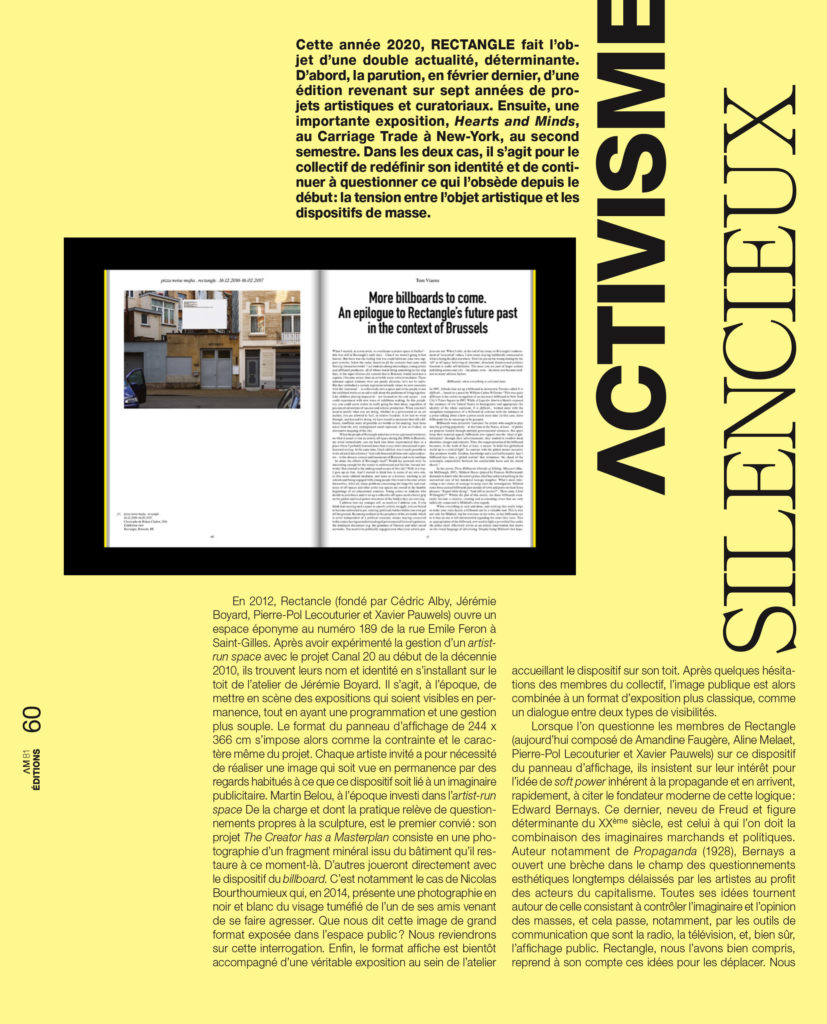
L’art même n°81

Edited by Jean-Baptiste Carobolante

download pdf