Old Master in the algocene
Rectangle presents “Old Master” at Wouters Gallery in Brussels, bringing together six artists — Alexandra Crouwers, Auriea Harvey, Joan Heemskerk, Jan Robert Leegte, Lorna Mills, and Clement Valla — whose practices map the entanglement of ecology and digital infrastructure. Working across photogrammetry, net art, GIF animation, generative software, and 3D scanning, their work converges on a condition rather than a thesis: the digital does represent nature. It has become part of its fabric.
Nature is not a backdrop to human civilisation. It is not something external that we act upon from a position of sovereign distance. We are inside it, and what we are unravelling is not nature in the abstract but the precise conditions that sustain us, and countless other forms of life, in their specificity. The ecological crisis is not a crisis of nature. It is a crisis of cohabitation, and it demands a post-anthropocentric rethinking of what constitutes an entity, what constitutes agency, and what constitutes our habitat.
That rethinking has entered a second phase. The Algocene names the moment at which algorithmic systems superimpose a pervasive digital infrastructure upon the physical transformations already in progress. A new nature has been taking shape, post-natural, hybrid, neither fully organic nor fully synthetic. The digital is not a representation of this emergent nature. It is embedded within it, an invisible yet decisive stratum that conditions every relation between organisms and their environments. The boundaries between human, machine, and the living world have been superseded.
“Old Master”, presented by rectangle at Wouters Gallery, is about the representation of nature in the digital era. It is not a digital art exhibition. Digital art asks what the computer can do; art in the digital age asks what the world has become now that the computer is inside it. The distinction is ontological, and “Old Master” belongs entirely to the second category: the digital here is not the medium or the subject but the condition, a restructuring of reality so complete that no practice can stand outside it. The canonical old masters painted nature from a position of exteriority: the surveyed estate, the storm endured, the garden subdued. Their images were acts of possession. In the Algocene, that exteriority has been foreclosed. The image is immanent to the system it renders. The scan is embedded in the landscape it reconstructs. The algorithm is a participant in the ecology it models.
Alexandra Crouwers’s “Summoning a Forest” (2026) is a photogrammetric reconstruction of a clear-cut woodland annihilated by Ips typographus, the bark beetle whose proliferation was accelerated by successive droughts and the collapse of frost cycles. Crouwers presents not the resolved model but the process: raw point cloud, untextured mesh, ghostly blue tracking markers registering her own movements through the site. She appears in the reconstruction as a lacuna. The forest has ceased to exist. Its data persists in a condition that is neither archive nor monument, a geometric ghost occupying coordinates that have no season and no entropy. The accompanying audio piece The Compositor / Composing closes the circuit: the beetle’s tunnel system, traced to paper and run through image sonification software, produces a sound that was never intended as music and is all the more devastating for it. Ips typographus means compositor, the one who sets type. The insect inscribes; the software deciphers; the forest is transposed into code it never elected. The biological and the computational are not analogous here. They are continuous.
Jan Robert Leegte’s “Waves” (2026) extends that continuity into the digital’s own stratigraphic logic. Bleached interface fragments, the residue of web 2.0 platforms, text worn past legibility, are suspended in an oceanic simulation at the precise moment they are being replaced by AI systems that generate content on demand and leave nothing behind that can be located, stored, or cited. The digital is subject to erosion, sedimentation, and irreversible loss of form. The Algocene metabolises its own prior iterations. “Shadow” (2025) works through the inverse register: an unattributable square of darkness traverses a wind-tormented Unity landscape with the pace of a geological event, admitting no explanation and permitting no removal. The computational intrusion has been so thoroughly absorbed into the sensory world as to have become indistinguishable from it.
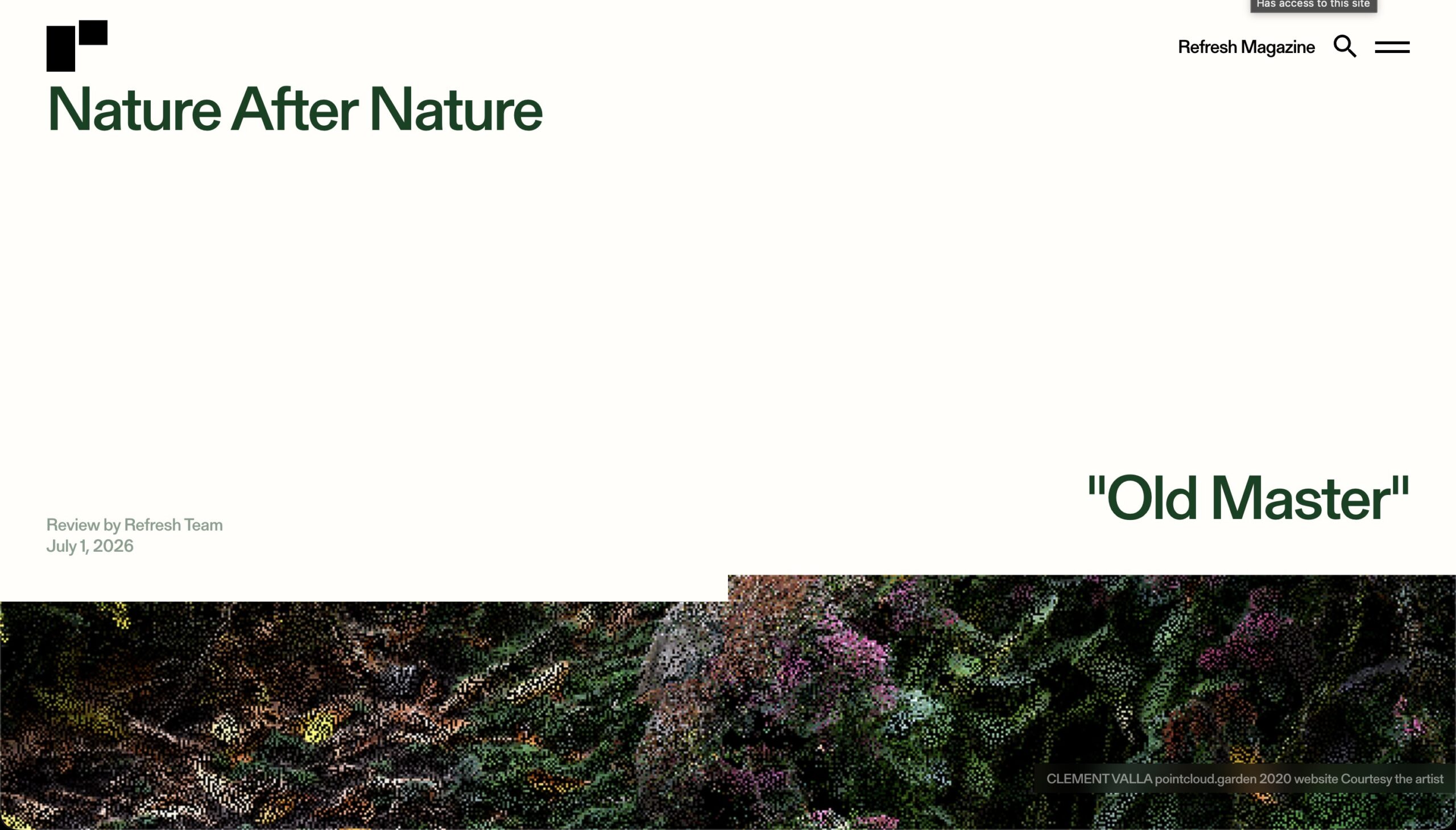
Clement Valla was a pioneer in understanding that the digitisation of the world is not a neutral act of recording but a system of choices, compressions, and distortions that produce their own version of reality. His earlier work exposed the structural failures of platforms like Google Maps, where the algorithm’s attempt to flatten a three-dimensional world onto a two-dimensional surface generates impossible geometries: bridges that fold into rivers, roads that dissolve into sky. The world, when processed, does not simply become data. It becomes a particular kind of data, shaped by the assumptions and limitations of the systems doing the processing. Pointcloud.garden (2020) and Overgrowth (2021) carry that inquiry into ecological territory. Gardens and yards released to rewilding are presented as raw 3D scan data, unprocessed, unresolved, held open at the threshold between image and object. The living world is now subject to the same biases, the same reductive translations, the same productive distortions that Valla identified in the digitisation of geography. The point cloud is not a representation of the garden. It is the garden in another state, shaped by the logic of the scanner as much as by the logic of growth. To relinquish a space to nature is also, now, to relinquish it to data. What appears to be a return is simultaneously a capture.
Joan Heemskerk’s Auquay (2019–ongoing) delineates the world’s coastlines exclusively from AIS shipping coordinates. The boundary between land and water is an artefact of signal infrastructure. The coast is where the data is.
Auriea Harvey’s Me and My Ghost (2001/2024) is a webcam capture reworked two decades after its making to exploit glitches that had not yet materialised when it was first produced. The digital has its own material temporality, its own modes of ageing and unforeseen mutation, its own capacity to become something other than what it was. Lorna Mills’s GIF animations, assembled from the most corrosive strata of the dark net, insist that the internet has an underside as decomposed and as generatively fecund as any ecosystem’s anoxic layer. Both works register the digital not as a clean infrastructure but as a living, degrading, self-transforming system, one that has acquired the opacity and the unruliness we once reserved for nature alone.
The title is precise. The old masters were not simply skilled painters. They were the authorised image-makers of a world in which nature was a resource, a spectacle, a possession. Old Master takes that authority and relocates it: to a moment in which the image-maker is inside the system being imaged, in which the forest and its scan, the coast and its signal, the garden and its data are not two things but one thing in two states. The Algocene has its own masters. They are working now.
Old Master — Wouters Gallery / rectangle, Brussels ( European Union) until 25 July 2026.
July 1, 2026, Refresh Team
more about Refresh Magazine